This is a longer-than-usual post as it comprises the work I have been doing over the past two years at #ChatterisMuseum on the short-lived coconut matting factory in Chatteris (Reliance Rug and Mat in Smarts Lane, later St Martin’s Road, shown in the historic OS map of the town which can be viewed on the National Library of Scotland site). Rather like Alice I fell down a rabbit hole and ended up collating all the names who worked in matting, horse clothing (tack etc) and a few rope makers for good measure!
The Alice in the title was Alice Wheeler, who worked in another matting factory, H. Price’s in Station Street, and was involved in a wonderfully bizarre court case against some of her co-workers in 1892. The newspaper report tells their story best:
Chatteris Petty Sessions ‘Cases of Snowballing’ – 6 young women employed in Mssr Price and Co’s Cocoa Matting Manufactory of Chatteris, were summoned by Alice Wheeler, a young woman employed by the same firm, for throwing snowballs and otherwise annoying her, on 7th January last. The defendants, who were all arranged at the Bar, being Florrie Savage, Sarah Ann Brown, Emma Casburn, Alice Pitchers, Mary Ann Miller and Jane Pack, all pleaded Not Guilty and the magistrates, though satisfied they were guilty, inclined to be lenient and ordered them to pay costs, 6s 9d each.’ (Cambridge Independent Press, 12/2/1892)
I started therefore with 7 young women at Price’s. Alice went on to marry Fred Wadlow, a cutter in the same factory. Digging further in census records, I ended up with 135 separate people (including Arthur Whetstone, whose story I have already blogged, and R, the weaver) but still lacked any records of the Reliance works. It appears that the factory was set up in the early 1890s and closed just before WWI. Price’s too, got into problems, judging by the number of people in 1921 reporting they had worked there but now were unemployed.
So what do we know? One thing that comes across clearly is that mat-making was hard, poorly-paid work, if it was paid at all: a newspaper report of 1903 about the Eastern Counties Asylum in Colchester, Essex, describes ‘lower-grade boys’ working stripping the coir from coconuts, and an earlier report on developing the industry noted that inmates in prisons were also engaged in this work.
It is not surprising therefore to find young women and girls in the majority in the list of Chatteris workers, and in this photo held in #ChatterisMuseum and used by kind permission, which was thought to show agricultural workers but which, I believe, may have been taken to mark the opening of the Reliance Works.
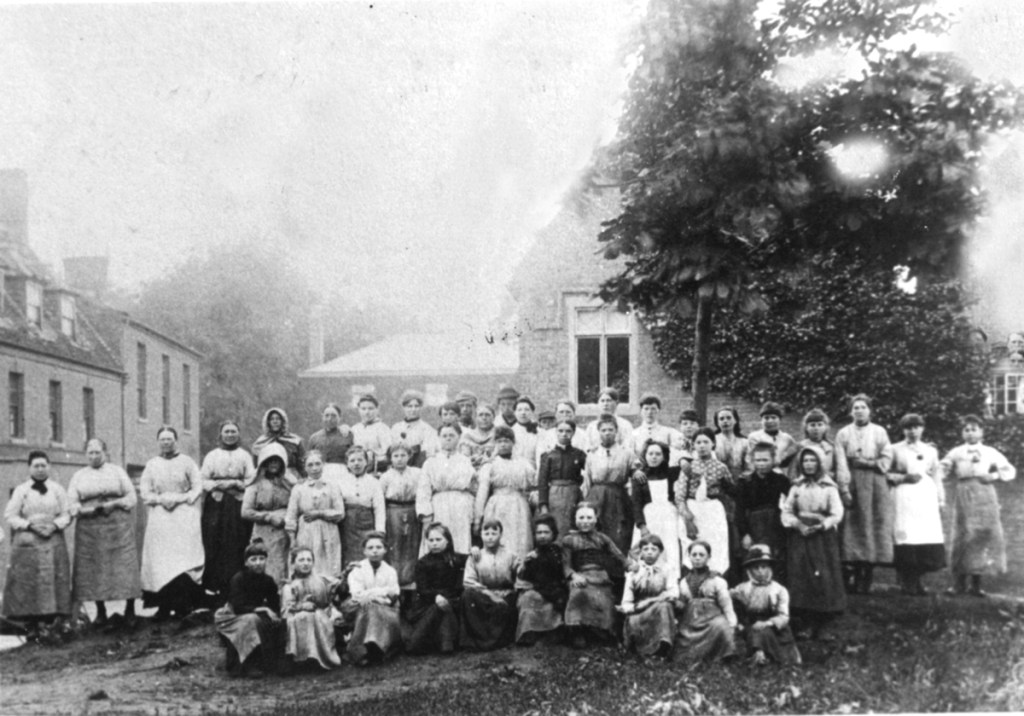
It seems that both factories made mats and what is described as ‘horse clothing’, i.e. tack, rugs and ropes. A weaver named Frederick Allen arrived in Chatteris from Suffolk and rose to be manager of the factory, and his daughters Minnie and Maud may be the two tall ladies in white blouses at the centre back of this picture (we have other pictures of Minnie, who went on to be a missionary in central Africa, to compare with).
John Newman, a saddler and employer who lived in Smarts Lane in 1891, may have been the driver behind the Reliance works, but we cannot say for sure. Investing in these ventures was risky: by 1893 we have reports of debts, and soon afterwards Newman’s business was in the hands of the Official Receiver. It was sold on to one Dr Edward Pratt of Waterbeach. Pratt in turn entered into a business partnership with a certain Mr Holmes, who had previously worked for Newman, but the latter was ‘found to be dishonest’, defrauding the business of £200 and leaving Pratt bankrupt in 1909. Holmes resurfaces in 1921, his name one of three partners in Price’s, but by that time none of the employees recorded in the census had a job there.
The list below collates all references to the workers I have turned up, including what they did before or after their time in the factories. Maybe one of them is a relative?
 LiveTheirStory
Leave a comment